Drew Schmitz · 2 September 2026
Recent analysis of lunar regolith returned by the Artemis III mission has identified unexpected concentrations of helium isotopes within surface samples collected from the Moon's south polar region. Researchers at LunarLab.edu.pl report that helium-4 levels exceed predictions by approximately 15 percent, while trace amounts of helium-3 appear higher than models based on prior Apollo data suggested. The findings challenge existing assumptions about solar wind implantation and volatile retention in permanently shadowed craters.
Sample Collection and Laboratory Methods
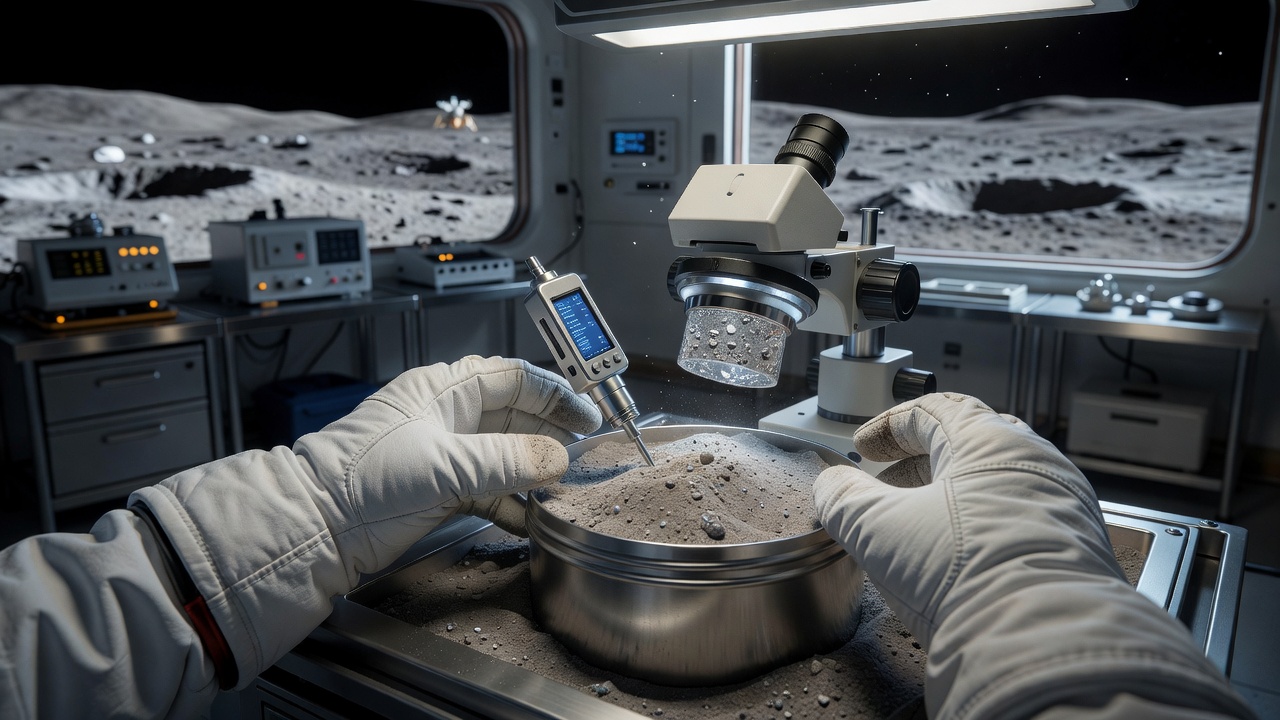
Teams processed 2.3 kilograms of regolith using mass spectrometry and noble gas extraction techniques at facilities in Poland and partner institutions. Measurements focused on grains smaller than 100 micrometers, where helium is predominantly trapped. Results indicate heterogeneous distribution, with elevated readings concentrated in ilmenite-rich particles. Control samples from equatorial latitudes showed standard solar wind signatures, confirming the anomaly is regionally specific. Cross-verification with neutron spectroscopy data from orbiting assets supports the laboratory observations. Scientists note that cosmic ray exposure ages align with expected timelines, ruling out recent contamination as a factor.
Further isotopic ratio analysis revealed a helium-3 to helium-4 proportion of 4.2 times 10 to the negative four, slightly above theoretical solar wind values. This deviation may reflect contributions from lunar interior outgassing or micrometeorite delivery mechanisms not fully accounted for in current models. Ongoing experiments aim to quantify diffusion rates under simulated lunar temperature cycles to refine retention estimates.
Scientific Implications and Future Research
The presence of enhanced helium traces carries potential significance for understanding lunar volatile cycles and resource prospecting. Helium-3 remains a candidate fuel for fusion energy concepts, though extraction feasibility requires additional in-situ demonstrations. Geologically, the data suggest localized shielding effects from crater topography that preserve volatiles more effectively than previously calculated. Mission planners are evaluating whether similar signatures appear in planned Artemis V sampling sites near Shackleton crater.
Collaborative studies will integrate these results with remote sensing from the Lunar Reconnaissance Orbiter and upcoming commercial landers. Publication of raw datasets is scheduled for the next Lunar and Planetary Science Conference. Researchers emphasize that replication across multiple laboratories remains essential before revising global regolith volatile budgets.