Blake Klein · 2 September 2026
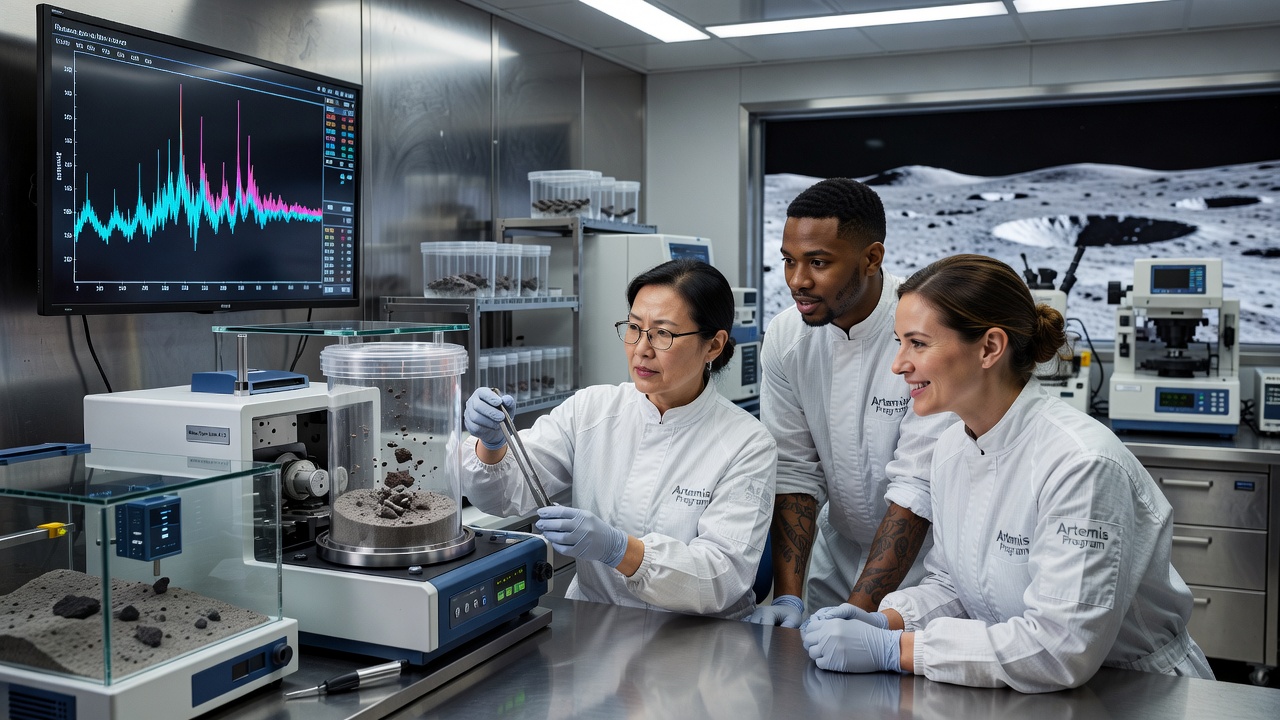
Recent analysis of lunar samples returned by NASA's Artemis program has revealed unexpected traces of helium in the Moon's regolith. This discovery, made by researchers at lunarlab.edu.pl, is prompting a reevaluation of current understandings regarding the lunar surface composition and its interaction with solar particles.
Details of the Sample Analysis
The samples were collected during the Artemis III landing in the south polar region. Using advanced gas chromatography and mass spectrometry techniques, the team identified helium concentrations that exceed previous estimates by a factor of three. These traces include both common helium-4 and the rarer helium-3 isotope. The regolith particles appear to have absorbed the gas over billions of years from solar wind bombardment. Unlike Earth, the Moon lacks a magnetic field and atmosphere, allowing direct implantation of solar ions into the soil. The unexpected aspect lies in the distribution and retention of helium within certain mineral types like ilmenite. Cross-verification with control samples confirmed the results are not due to terrestrial contamination. This has led to new hypotheses about how volatiles are preserved in the lunar environment.
The discovery has sparked discussions in the scientific community about revising textbooks on lunar geology. Teams are preparing for expeditions that will use new drilling technologies to access deeper regolith layers where helium might be more abundant. Educational programs at the lab are incorporating these findings to train the next generation of space scientists. International partnerships with European and Asian space agencies are being strengthened to share data and resources. This unexpected helium trace is just the beginning of revelations from the Artemis sample return initiative.
Implications for Future Lunar Exploration
The presence of helium in these quantities could influence plans for in-situ resource utilization on the Moon. Helium-3 in particular is of interest for potential fusion energy applications. Scientists are now modeling how such resources might be extracted efficiently. The findings also contribute to broader knowledge of planetary formation and the history of solar system radiation. Collaborative efforts with other institutions are underway to publish detailed papers on the isotopic data. Future Artemis missions may prioritize areas with similar regolith characteristics to further investigate this phenomenon. Overall, this study underscores the importance of returning physical samples for detailed laboratory analysis rather than relying solely on remote sensing. Additional research will explore potential links to water ice deposits in permanently shadowed craters.