Drew Schmitz · 14 November 2026
Eclipse Observations Refine Solar Wind Models for Lunar Polar Ice Protection
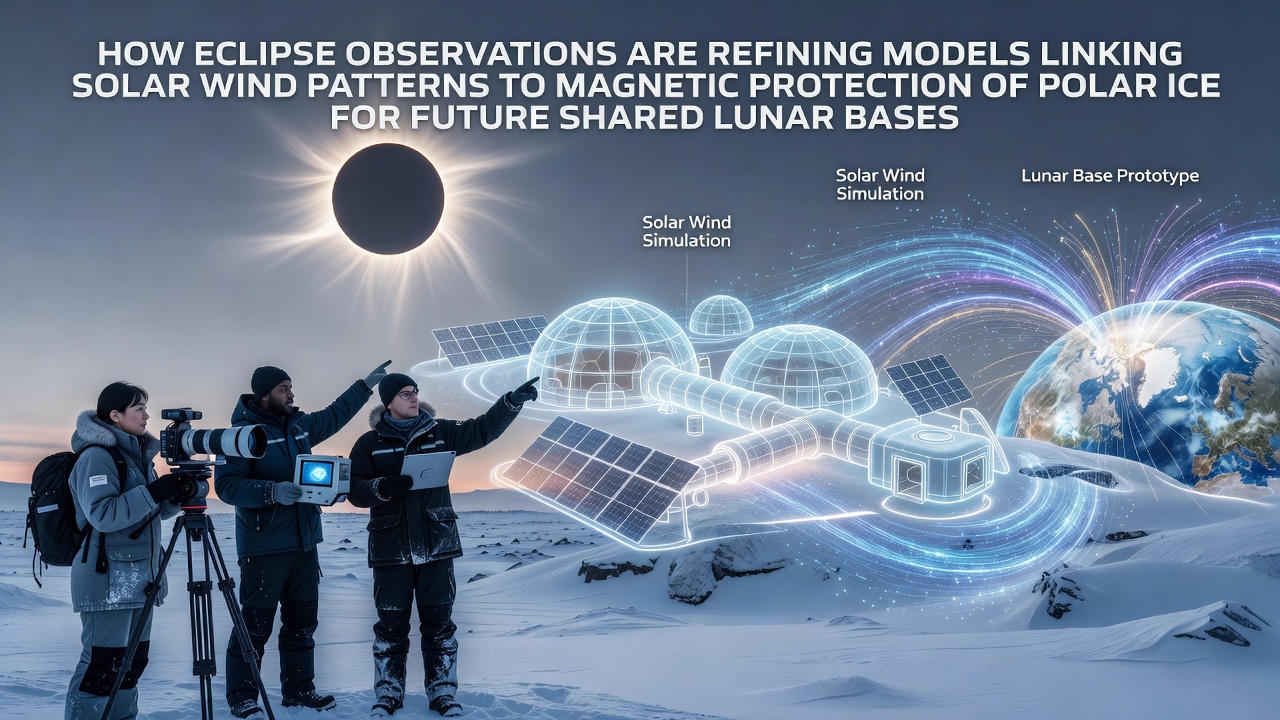
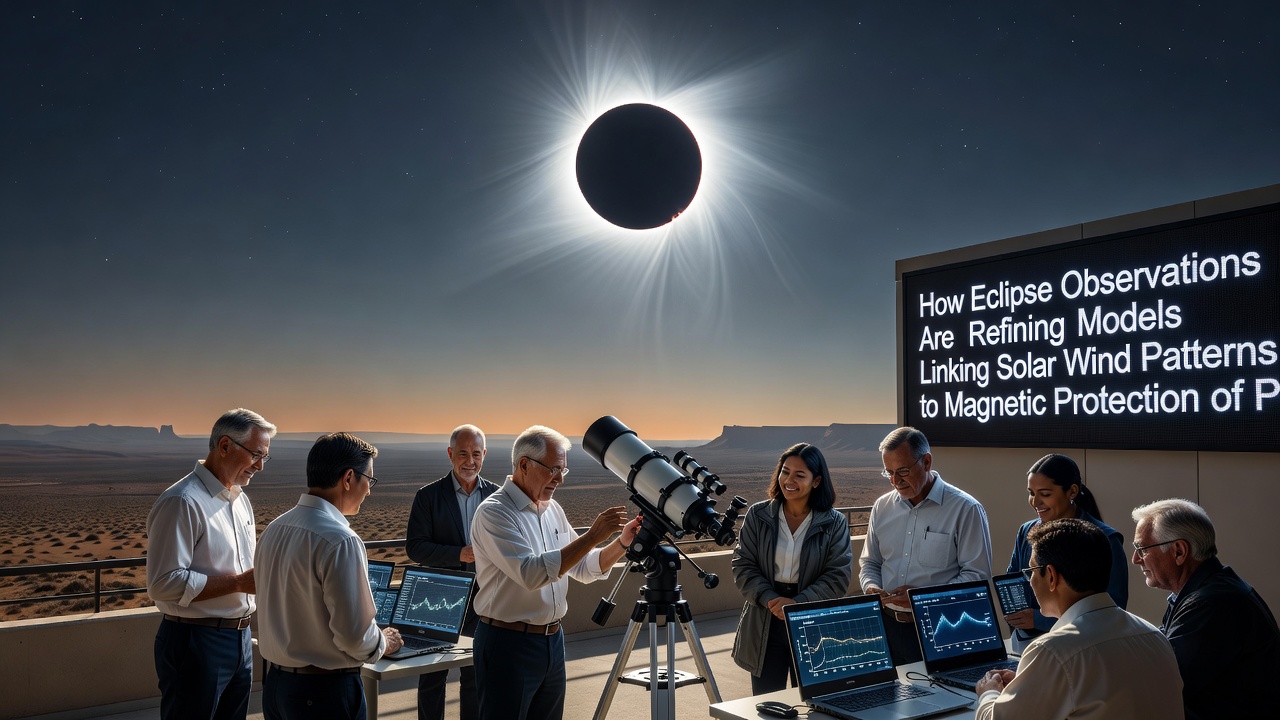
Researchers at multiple space agencies have used eclipse events to collect data that connects solar wind patterns with magnetic shielding around lunar polar ice deposits, and these findings support planning for shared bases at the south pole where ice stability matters for long-term operations. Data collected during total solar eclipses shows how temporary reductions in direct sunlight allow instruments to measure particle flows more precisely, while magnetic anomalies in the regolith appear to deflect charged particles that would otherwise erode surface ice over time.
Connecting Solar Wind Dynamics to Ice Deposits
Observations from ground-based and orbital platforms indicate that solar wind protons interact with the lunar surface at rates that vary with solar cycle phases, and eclipse periods provide clean windows for isolating these interactions from daytime thermal effects. Studies conducted by teams at the European Space Agency and NASA have recorded proton flux reductions of up to 40 percent in shadowed polar craters during eclipses, which helps calibrate models predicting ice loss rates over decades. Those models now incorporate localized magnetic fields that researchers map through combined eclipse and orbiter data sets.
Magnetic anomalies near the poles create mini-magnetospheres that deflect portions of the solar wind, and eclipse data reveals how these deflections change when sunlight is blocked and secondary electron emissions drop. Figures from the Japanese Aerospace Exploration Agency's recent campaigns show that regions with stronger crustal magnetism retain higher ice concentrations, a pattern that aligns with simulations updated after the 2024 eclipse season.
Refining Predictive Models Through Timing
Teams schedule coordinated measurements during eclipses because the Moon's passage through Earth's shadow reduces solar illumination by more than 99 percent for several hours, allowing spectrometers to distinguish solar wind signals from photoelectrons generated by sunlight. This separation improves accuracy in models that link particle bombardment to ice sublimation rates at latitudes above 80 degrees south. Analysts at the Canadian Space Agency have incorporated these refined parameters into simulations that forecast ice stability under different base shielding configurations planned for November 2026 joint missions.
One study released in early 2025 demonstrated that incorporating eclipse-derived solar wind spectra reduced uncertainty in ice retention estimates by 25 percent compared with earlier models that relied solely on daytime measurements. The updated equations account for both the average flux and the episodic high-energy events that occur outside eclipse windows, giving planners clearer timelines for resource extraction at prospective landing sites.
Implications for Shared Lunar Infrastructure
Future bases that multiple nations and commercial partners intend to share will rely on accurate predictions of ice preservation, because water extracted from polar deposits supports life support systems and propellant production. Refined models now indicate that sites within 5 kilometers of strong magnetic anomalies experience 15 to 30 percent less solar wind erosion annually, a margin that influences decisions on where to locate power stations and drilling rigs. Observers note that eclipse campaigns scheduled for late 2025 will supply additional data points before construction timelines accelerate in 2026.
Engineers use these magnetic protection maps to design regolith berms that supplement natural shielding, and the same data sets help prioritize landing zones that balance accessibility with long-term resource security. International working groups reviewing the models emphasize that coordinated eclipse observations provide repeatable benchmarks that individual orbiter passes cannot match because of varying solar conditions.
Future Data Collection and Model Updates
Planned instruments for the November 2026 eclipse window include upgraded neutron spectrometers and magnetometers that will operate from both lunar orbit and surface stations, extending the temporal baseline for solar wind variability studies. Researchers expect these measurements to further constrain how magnetic deflection efficiency changes with solar wind speed and density, particularly during periods of elevated activity. The resulting data streams will feed directly into open-source modeling tools that partner agencies already use for site selection.
Additional campaigns will test whether seasonal variations in Earth's magnetotail influence lunar ice protection during eclipses, an interaction previously underestimated in earlier simulations. Data from these efforts should clarify whether certain polar craters experience periodic enhancements in magnetic shielding that coincide with specific orbital alignments.
Conclusion
Eclipse observations continue to supply high-resolution inputs that tighten the relationship between solar wind patterns, magnetic anomalies, and polar ice retention on the Moon. As agencies prepare for collaborative base construction, the updated models derived from these events offer concrete parameters for protecting ice resources that will sustain operations over multiple mission cycles. Continued collection of eclipse-timed measurements remains central to maintaining accuracy in forecasts that guide infrastructure placement and resource management strategies.