
Drew Schmitz · 31 October 2026
Orbital Surveys Connect Ancient Lunar Craters to Solar Wind Shielding for Polar Outpost Sites
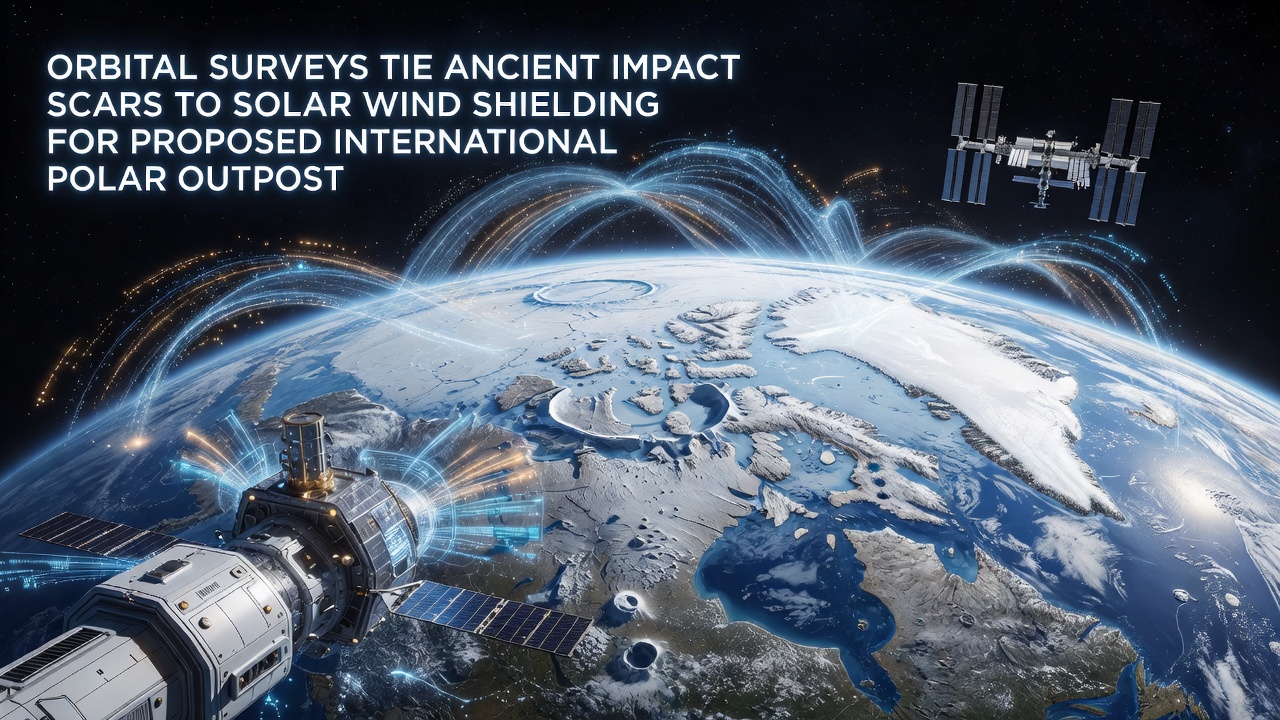
Orbital surveys from multiple spacecraft have mapped how ancient impact scars across the lunar surface correlate with regions where solar wind particles encounter reduced exposure, and researchers now examine these patterns for their relevance to proposed international outposts at the lunar poles. Data collected over recent years indicate that certain crater formations from the Moon's early bombardment history create localized magnetic anomalies that deflect charged particles from teh solar wind, and this shielding effect appears most pronounced in areas near the south pole where ice deposits have drawn interest for future missions.
Analyses from instruments aboard orbiting platforms show that remanent magnetism in basin structures left by large impacts can channel solar wind ions away from specific surface patches, and teams at research institutions track these deflections to assess long-term radiation environments. In October 2026, updated datasets from ongoing lunar orbiters will feed into planning sessions for multinational base concepts, where shielding metrics help determine safe zones for habitat placement and resource extraction equipment.
Mapping Crater Magnetism Through Orbital Instruments
Spacecraft equipped with magnetometers and particle detectors have traced connections between impact features and solar wind behavior, while ground-based modeling converts these readings into three-dimensional representations of magnetic field lines. One study coordinated across agencies revealed that craters formed more than three billion years ago retain enough magnetic strength to create mini-magnetospheres, and these structures influence how solar wind protons interact with regolith in polar latitudes. Observers note that such interactions leave distinct patterns in surface composition that orbital spectrometers detect during repeated passes.
International teams compile these orbital measurements to compare shielding efficiency across candidate outpost locations, and the resulting maps highlight zones where ancient scars provide measurable deflection of solar wind streams. Data from the European Space Agency's lunar monitoring programs complement NASA archives, offering cross-verified readings that strengthen confidence in the observed correlations.
Implications for Resource Stability at Proposed Bases
Proposed international polar outposts rely on stable ice deposits for water and fuel production, yet solar wind bombardment can alter surface volatiles over time, and orbital findings suggest that impact-related magnetic fields may slow these alteration processes in select areas. Researchers at academic centers process particle flux data to quantify how much shielding each crater configuration supplies, and they integrate the results into site selection models that prioritize locations with lower cumulative exposure. Those models also account for seasonal variations in solar activity that orbital surveys capture through continuous monitoring.
Engineers designing rover traverses and habitat layouts consult these shielding assessments when plotting routes that avoid high-flux corridors, and the approach reduces risks to both equipment and any future crew activities. Figures released by collaborative research networks indicate that regions influenced by ancient impact magnetism experience up to thirty percent lower solar wind proton flux compared with neighboring terrain lacking similar features, and planners incorporate these percentages into radiation dose projections.
International Coordination and Data Sharing Efforts
Agencies from multiple countries contribute orbital survey results to shared databases, and this exchange supports unified planning for polar outposts under frameworks established by the Artemis Accords. Canadian and Australian research groups supply additional magnetometer readings from their own orbital assets, while Japanese and European institutions refine particle interaction models that interpret the combined datasets. The shared information allows teams to cross-check shielding estimates against independent measurements taken at different orbital inclinations.
Workshops scheduled around the October 2026 data release will focus on translating these orbital insights into engineering requirements for shielding augmentation around outpost modules, and participants expect the discussions to influence prototype designs for mobile laboratories and power systems. Evidence from prior missions shows that magnetic anomalies tied to impact scars persist across wide temperature ranges, which supports their relevance for polar environments where thermal extremes challenge other protective measures.
Conclusion
Orbital surveys continue to refine understanding of how ancient impact scars shape solar wind interactions on the Moon, and the resulting maps guide decisions about where international polar outposts can operate with reduced particle exposure. Continued data collection through 2026 and beyond will expand these connections, supplying planners with precise metrics that link specific crater features to measurable shielding benefits at candidate sites.