Sofia Klein · 3 October 2026
Student Payloads on Commercial Landers Unlock Fresh Connections Between Magnetic Anomalies and Polar Ice Stability Protocols
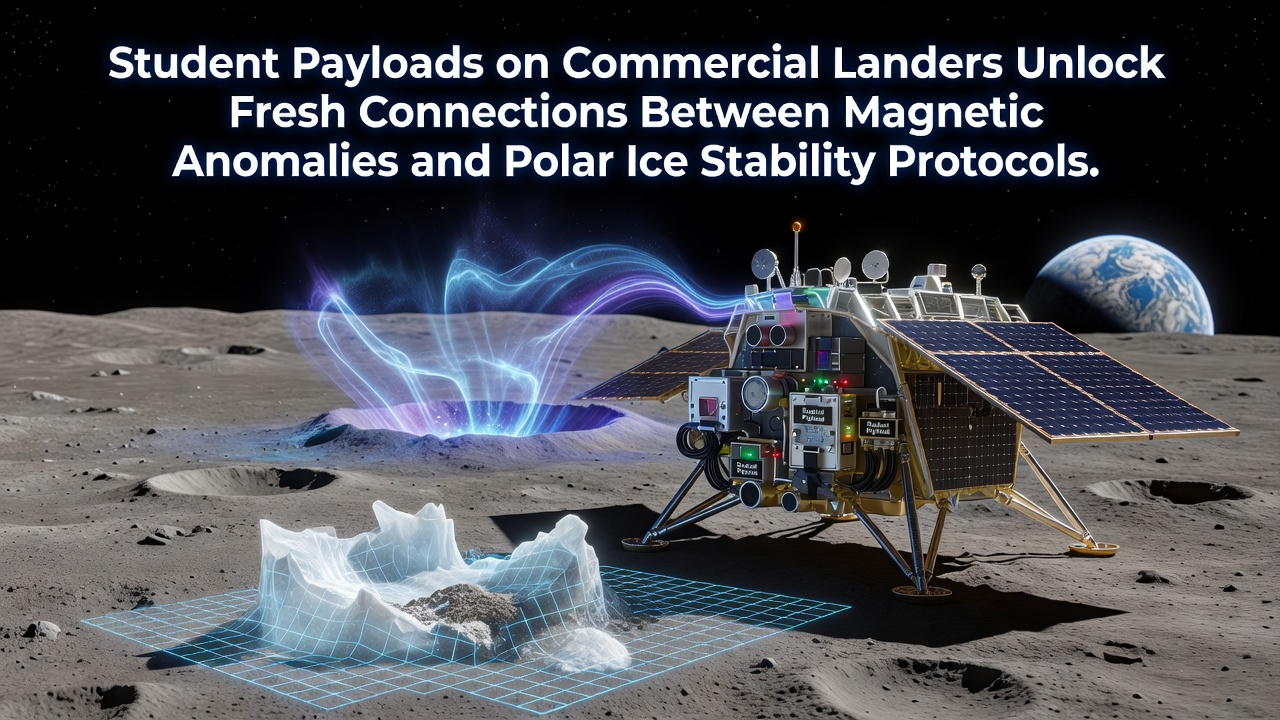
Commercial landers have started carrying student-designed payloads that measure subtle magnetic variations while mapping ice deposits at the lunar poles, and researchers note how these combined datasets reveal new patterns in surface stability. Data from recent missions show that regions with stronger magnetic anomalies often coincide with areas where ice remains more consistent over seasonal cycles, which suggests the magnetic fields may influence local particle behavior and volatile retention.
Payload Designs and Mission Integration
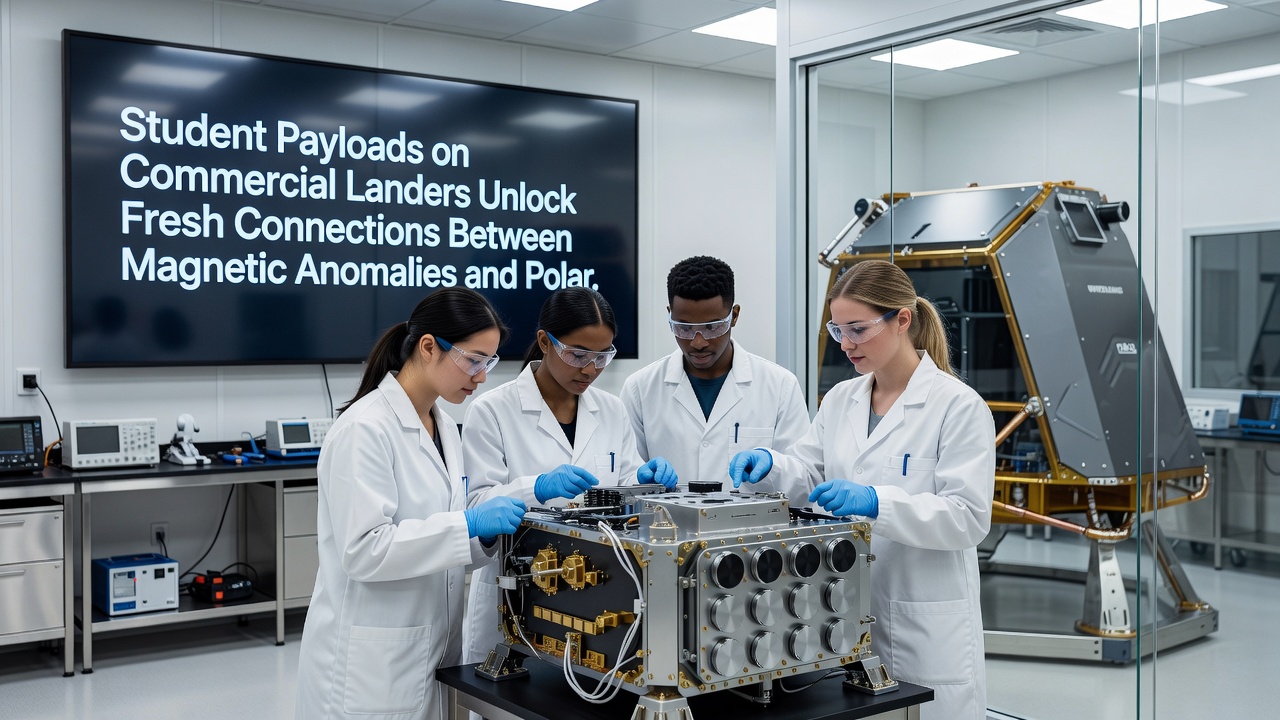
Teams at universities across North America and Europe have developed compact magnetometers adn spectrometers that fit within the mass and power limits of private lunar landers, and these instruments collect readings during descent, landing, and surface operations. One payload suite includes a fluxgate sensor paired with a neutron detector, while another combines a vector magnetometer with temperature probes that track regolith conditions at multiple depths. Integration occurs through standardized interfaces provided by the lander operators, which allows student groups to upload firmware updates and receive telemetry streams without direct control over the spacecraft bus.
Engineers at several institutions report that calibration sequences run during Earth orbit and cislunar transit reduce noise levels enough for the student instruments to detect anomalies as small as a few nanotesla. The payloads operate on duty cycles that align with communication windows, and raw measurements return to ground stations for processing by student analysts who compare them against orbital survey archives from earlier probes.
Linking Magnetic Fields to Ice Distribution
Analysis of landing site data indicates that magnetic anomalies near the south pole often border or overlap with permanently shadowed regions where ice concentrations exceed average background levels. Scientists at multiple research centers observe that charged particles deflected by local magnetic structures may reduce sputtering rates on exposed ice grains, which helps maintain higher stability over time. Ground teams combine these surface readings with orbital neutron data to refine models of hydrogen distribution, and early comparisons suggest the correlation holds across several independent landing locations.
Protocols for ice stability assessment now incorporate magnetic field strength as an additional variable in resource mapping efforts, and mission planners adjust landing ellipses accordingly to avoid zones where anomalies might indicate altered regolith cohesion. In October 2026, follow-on commercial missions plan to deliver updated student instruments that add electrostatic field sensors, which could further clarify how magnetic and electric forces interact with volatile ices in the same terrain patches.
Data Processing and Student Contributions
Student teams apply open-source algorithms to separate diurnal temperature effects from longer-term magnetic trends, and they share processed maps through university repositories that feed into larger lunar science databases. Cross-checks against records from government agencies such as NASA's Lunar Reconnaissance Orbiter confirm that the commercial lander measurements fill spatial gaps left by orbital passes. European partners contribute through ESA-supported data archives that standardize formats for multi-mission comparisons.
Case examples include one payload that detected a localized magnetic enhancement coinciding with a crater wall where ice signatures persisted through multiple lunations, while another recorded weaker fields in an adjacent area showing greater ice variability. These observations undergo peer review at student-led workshops before integration into broader stability protocols used by commercial operators.
Future Mission Planning and Protocol Updates
Commercial providers review the combined magnetic and ice datasets when selecting sites for resource prospecting drills, and they incorporate student-derived thresholds for anomaly strength into risk assessments. Updated protocols call for repeated measurements at the same coordinates across successive landers, which builds time-series records that track any seasonal or solar-cycle influences on both magnetism and ice retention. Academic groups continue refining payload designs to include higher-resolution sensors that could resolve smaller-scale features within known anomaly clusters.
Conclusion
Student payloads aboard commercial landers continue supplying measurements that tie magnetic anomalies more directly to polar ice behavior, and the resulting datasets support refined stability protocols for future surface activities. Ongoing missions through 2026 and beyond will test whether these connections hold across additional sites, while expanded student participation broadens the range of instruments and analytical approaches applied to the same core questions.